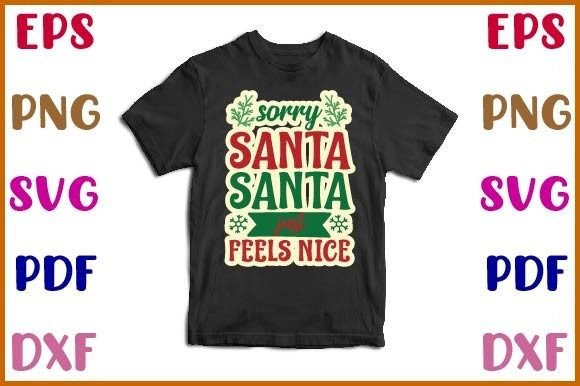
Sorry Santa Just Feels Nice Review
As a designer who spends more time staring at stitch charts than sleeping, I approach every new digital asset with a healthy dose of skepticism. The market is flooded with generic holiday clipart that looks muddy when converted to thread. However, Sorry Santa Just Feels Nice Sticke caught my eye not just for its humorous twist on seasonal tropes, but for its potential as a viable commercial embroidery design. I recently pulled this file from the Crafts and Graphics categories to test it in a real-world scenario: creating a line of boutique holiday merchandise for an upcoming craft fair.
First Impressions and Visual Personality
The title itself does heavy lifting. It sets a tone that is relatable, slightly rebellious, and undeniably cozy. For the modern crafter or Etsy seller, humor sells. But humor in embroidery is tricky; if the lettering is too thin or the layout too complex, the joke gets lost in the fabric. My initial assessment of Sorry Santa Just Feels Nice Sticke was positive regarding its visual hierarchy. The phrase suggests a bold, readable font structure, which is critical for machine embroidery where fine details often disappear.
The mood created by this design is casual warmth. It doesn’t scream traditional Christmas elegance; instead, it whispers comfort. This makes it perfect for apparel decorators looking to move away from stiff, formal holiday wear and toward relaxed, wearable art. The visual personality feels like something you would wear while drinking cocoa by a fire, rather than attending a formal gala. This distinction matters because it dictates your target audience: people who value comfort and wit over tradition.
Real-World Application: The Tote Bag Test
To truly evaluate an embroidery project, you have to see it on a three-dimensional object. I decided to digitize and stitch this design onto a natural canvas tote bag, a staple item for any craft business. The goal was to see how the text held up against the rough texture of the canvas and whether the layout balanced well on the front panel.
Using a standard hoop size, the placement worked beautifully. The design’s width allowed for comfortable readability without overwhelming the bag’s surface area. When stitched, the contrast between the dark thread and the natural canvas made the message pop. Customers at craft fairs respond instantly to relatability. A customer didn’t need me to explain the joke; they laughed immediately. This immediate emotional connection is what drives sales for personalized gifts and holiday embroidery items. The design successfully translated from a flat digital image to a tactile, engaging finished product.
Performance on Custom Apparel and Baby Items
Beyond bags, I considered how Sorry Santa Just Feels Nice Sticke would perform on custom apparel. Specifically, I looked at sweatshirt embroidery and baby clothes. For a unisex sweatshirt, this design fits perfectly in the center chest or left pocket area. The humor works well on heavier fabrics like fleece or cotton blends, where the stabilizer can provide ample support to prevent puckering.
However, the application shifts when moving to baby embroidery. While the sentiment is sweet, the "Santa" reference might be slightly ironic for infants. Yet, parents love buying ironic gifts for their kids. If used on a onesie or a baby blanket, the design should be scaled down slightly to maintain delicacy. In these cases, the clarity of the stitches becomes paramount. You want the viewer to see the quality of the work, not just read the words. The design’s inherent simplicity aids this; there are no overly intricate flourishes that could trap lint or look messy after washing.
Where to Exercise Caution
No design is universal, and Sorry Santa Just Feels Nice Sticke has specific limitations that designers must respect. First, avoid using this on highly textured fabrics like chunky knits or bouclé unless you are an expert. The irregular surface will distort the stitching, making the text hard to read. Similarly, stretchy fabrics require careful hooping and potentially a cut-away stabilizer to prevent the design from warping during wear.
Small hoop sizes are another pitfall. If you attempt to cram this full phrase into a tiny 4x4 inch hoop, the lettering may become cramped, leading to thread breaks or poor registration. Always check the required hoop size before committing to a small accessory like a hat or a small patch. Furthermore, be wary of using this on dark fabrics with light thread unless you plan underlay stitching properly. Without proper underlay, the top threads may show through the fabric weave, giving a cheap appearance.
Also, consider the long-term durability. If this design is intended for a kitchen towel or a frequently washed apron, ensure the stitch density is appropriate. Too dense, and the fabric becomes stiff; too sparse, and the design wears out quickly. I recommend testing the design on scrap fabric first to gauge how the stitch density interacts with your specific material.
Technical Notes for the Digital Embroidery File
From a technical standpoint, having access to multiple formats like AI, SVG, EPS, DXF, JPEG, and PNG is a huge advantage for a digital embroidery file seller. It allows for seamless integration into various design software suites. However, remember that vector files do not contain stitch data. You still need to digitize or convert these assets carefully.
When preparing this for production, inspect small details closely. Even in a simple text design, the curves of letters like 'S' and 'a' need smooth transitions to avoid jagged edges in the final stitch-out. I also advise converting your mockups to black and white to check contrast levels. If the design looks muddy in grayscale, it will likely look muddy in color on the fabric. Use proper stabilizer choices based on the fabric weight; tear-away for stable wovens, cut-away for knits and stretchy materials.
Commercial Viability and Brand Consistency
For Etsy sellers and small shop products, consistency is key. This design fits neatly into a broader collection of holiday-themed assets. It pairs well with other winter motifs, allowing you to create cohesive bundles. The humorous angle helps build brand recognition; customers remember designs that make them smile. By offering Sorry Santa Just Feels Nice Sticke as part of a curated collection, you increase the perceived value of your design assets.
Ultimately, this design succeeds because it balances aesthetic appeal with practical usability. It is not overly complicated, yet it carries enough personality to stand out in a crowded marketplace. Whether you are creating embroidered patches, tote bag designs, or sweatshirt embroidery, this file provides a solid foundation. Just remember to test thoroughly, respect the fabric’s properties, and always confirm licensing terms before selling finished items. With careful execution, Sorry Santa Just Feels Nice Sticke can be a standout addition to your holiday inventory.